Saturday, September 13, 2014

A Review of a Trio of Federal Bills Promoting Renewable Energy on Federal Lands

By Nick Lawton, Policy Analyst
The U.S. House of Representatives is considering a trio of bills to stimulate renewable energy development on federal lands. Two of these bills, H.R. 1363 and H.R. 2004, focus on geothermal energy development, while the third, H.R. 596, focuses on solar and wind energy development. Two of the bills, H.R. 2004 and H.R. 596, are sound policies that should successfully promote renewable energy while preserving the environmental and economic viability of U.S. public lands. However, H.R. 1363 would unwisely and unnecessarily sacrifice the federal environmental review process under the National Environmental Policy Act (NEPA). Congress should pass H.R. 2004 and H.R. 596, but should abandon H.R. 1363.
H.R. 1363 would exempt geothermal exploration from the NEPA review process. Under the bill, a leaseholder would need only to notify the Bureau of Land Management (BLM) 30 days before drilling a well to test geothermal energy productivity. The agency would then have 10 days to review the project to determine if it meets the bill’s criteria for an exempt geothermal exploration project. If so, the project would require no further environmental analysis. If not, the BLM would have to explain why the project does not meet the bill’s criteria and give the leaseholder the opportunity to amend the project and again seek to qualify for the NEPA exemption.
H.R. 1363’s exemption from NEPA would be a radical departure from the currently required environmental review of proposed geothermal energy projects. NEPA, which has guided federal agencies for more than forty years, not only requires a consideration of the proposed project’s environmental impacts, but also requires consideration of a significant range of alternative projects. However, under H.R. 1363, federal land managers would have neither a duty nor discretion to review a geothermal exploration project’s environmental impacts. Consequently, H.R. 1363 would deprive federal decision-makers and the public of information necessary to make sensible, informed decisions about the merits of geothermal exploration. In fact, the Department of the Interior opposes H.R. 1363 for precisely this reason. Fortunately, H.R. 1363 seems unlikely to pass, as only two representatives have agreed to sponsor it.
H.R. 2004, (a.k.a S. 363) also focuses on geothermal energy, but does so without sacrificing important principles of environmental review. This bill would allow viable geothermal energy projects to lease one neighboring parcel of up to 640 acres on a non-competitive basis. The bill aims to solve a simple, concrete problem: once a geothermal resource is proven, competitors can speculatively bid for leases of nearby plots of land, which can deter investment in geothermal exploration and may even threaten the ongoing viability of a proven resource by tapping into the same source of geothermal energy. By allowing geothermal leaseholders essentially to expand their existing leases, H.R. 2004 would deter this sort of speculation and promote geothermal energy development. Because the non-competitive leases would still be issued at fair market value, the budgetary impact should be minimal. H.R. 2004 is good renewable energy policy, and the Senate has already passed it. The House should pass it promptly.
The broadest of the three bills, H.R. 596 would open U.S. rangeland and national forests to competitive leasing for renewable energy development. Currently, renewable energy development on public lands proceeds through individual applications for rights of way under the Federal Land Policy and Management Act and the National Forest Management Act. The existing system is likely less efficient and less remunerative than H.R. 596’s proposed competitive bidding system. However, BLM testified to the House Subcommittee on Energy & Mineral Resources that the agency has already used its existing statutory authority to authorize construction of 52 large wind and solar projects, with nameplate capacity of over 10,000MW. Moreover, BLM also testified that it is already using existing authority to implement competitive bidding on certain land the agency deems especially suitable for solar power. This testimony from BLM reveals that the federal government is already working toward the goals of H.R. 596.
Still, H.R. 596 would still be a boon to renewable energy development for two important reasons. First, the bill would open for leasing far more land than BLM has already approved. BLM currently focuses on particular parcels of land, such as Solar Energy Zones, deemed best-suited for development. These Solar Energy Zones comprise roughly 285,000 acres. In contrast, H.R. 596 would open for competitive leasing all public lands except those that BLM or the Forest Service have formally excluded from solar or wind development. In other words, H.R. 596 would make available vastly more land for renewable energy leases.
Second, H.R. 596 would establish a royalty-splitting scheme that would attract broad support for renewable energy development by benefitting states, local governments, federal agencies, and the environment. Currently, all revenue from solar and wind development on public lands flows directly to the U.S. treasury. Neither states nor local governments receive any portion of lease revenues, and funding for agency permitting and environmental projects is contingent on congressional appropriations. H.R. 596 would fundamentally alter this arrangement by dividing lease revenues: 25% would flow to counties where renewable energy development takes place, 25% to the state, 25% to a Renewable Energy Resource Conservation Fund, 15% to the federal agency responsible for permitting, and 10% to the U.S. treasury. This division of royalties would ensure that various stakeholders see direct fiscal benefits from renewable energy development and should thus garner broad support for renewable energy.
In fact, the royalty-splitting scheme has already attracted broad support for H.R. 596. A representative from the Arizona Governor’s Office of Energy Policy supported the bill strongly, noting that it would help the state “become the Solar Capitol of the World.” The National Association of Counties also supported the bill, noting that for one Arizona county, projected revenues from renewable energy leases would equal a 10% property tax increase. The bill’s proposed conservation fund, which would preserve and restore habitat and recreational use of public lands, also attracted support from environmentalists, such as The Wilderness Society and Trout Unlimited. In total, 58 organizations have endorsed the bill, and 60 U.S. Representatives from both sides of the aisle have co-sponsored it. The House of Representatives should act swiftly to pass H.R. 596 in order to modernize and promote renewable energy development on public lands.

Friday, September 12, 2014

Hawaii PUC Envisions Diminished Utility Ownership of Generation Facilities

By Nate Larsen, Energy Fellow
On April 28, Hawaii’s Public Utility Commission outlined a bold new vision for the role of electric utilities in the state. Rejecting the Hawaiian Electric Companies’ (HECO Companies’) Integrated Resource Planning Report for being “in part, a series of unrelated capital projects without strategic focus on the clear issues facing the utilities,” the PUC ordered the consolidated utilities to file a Power Supply Improvement Plan (PSIP) that establishes the steps that the utilities will take to expeditiously retire inefficient fossil-fuel generation facilities, increase generation flexibility, adopt new technologies like demand response and energy storage, and enable the integration of diverse renewable energy resources.        
To provide direction to the HECO Companies, the PUC issued a guidance document, Commission’s Inclinations on the Future of Hawaii’s Electric Utilities, which set out policy measures to modernize the generation, transmission and distribution systems, and recommended policy and regulatory reforms to reach Hawaii’s goal of 40% renewable energy by 2030.
This post focuses on the significance of one of the Hawaii PUC’s proposed reforms, the diminishing role of electric utilities as owners and operators of generation facilities. Other aspects of the PUC’s guidance, including rate modifications to better account for distributed generation, will be covered in the coming weeks.
The Times They Are A-Changin’
In the Commission’s Inclinations, the PUC submitted that it will consider whether it is reasonable and in the public interest to preclude the HECO Companies from ownership of new generation to combat what the PUC identified as the financial conflicts inherent in utility ownership of generation. The Commission forecast that “the HECO Companies’ traditional role as owner and operator of a fleet of fossil generation units will diminish over time as old, inefficient utility generation is retired and if new renewable and fossil generation is developed solely by [Independent Power Producers].” The Commission reasoned that the utilities both lack the expertise in developing new renewable facilities and are unable to economically compete with Independent Power Producers in developing new generation.
According to the policies proposed by the PUC, the HECO Companies’ future will center on the utilities’ role as the owners and managers of a transmission and distribution grid system. According to the PUC, the HECO Companies are well situated to develop and operate the modern grid infrastructure required to integrate and deliver the large quantities of renewable energy envisioned by Hawaii’s aggressive Renewable Portfolio Standard. Serving in that capacity, the HECO Companies’ role would be analogous to that of the Independent System Operators (ISOs) on the mainland, managing the bulk power system by dispatching energy resources, while maintaining reliability and minimizing costs.
The Commission suggested that the financial impact on the HECO Companies under this proposal would be limited by the fact that modern electric system will require substantial investments in transmission and distribution infrastructure, investments that may be included in the utilities’ rate base and thus earn a rate of return.
Some Things Change, Some Stay The Same
The HECO Companies filed their PSIP on August 26 in accordance with the Commission’s order, but failed to address the Commission’s suggestions regarding utility ownership of new generation assets. The PSIP outlined the utilities’ plan to comply with Hawaii’s Renewable Portfolio Standard goals, proposing considerable investments in renewable energy resources, modifications to their transmission and distribution systems, upgrades to the utilities’ existing thermal generation fleets and the development of infrastructure to support the importation, distribution and combustion of liquefied natural gas (LNG). The PSIP leaves the question of whom the HECO Companies expect to be making these significant investments, the issue brought up in Commission’s guidance document, unanswered.
It seems likely that the HECO Companies would prefer to maintain their position as owners and operators of a large portion of the generation fleet, because that is the role their business model is designed around. If that is the case, then the opacity of the PSIP regarding investments in new generation infrastructure is probably intentional on the part of the utilities. The utilities’ decision to avoid the issue of generation ownership in the PSIP might set up a battle over who should be responsible for developing new renewable and fossil generation in the future.
The PUC is currently evaluating the HECO Companies’ PSIP for consistency with the Commission’s orders and the state’s energy goals. Stripping the utilities of their traditional role as large-scale owners and operators of generation assets would redefine the function of an electric utility in Hawaii, and might bear on the future actions of policymakers and regulators on the mainland.
As Hawaii Goes, So Goes the Nation
The upheaval in Hawaii might have implications for the electric industry in the continental United States. The factors that drove Hawaii’s PUC to propose the significant policy reforms in the Commission’s Inclinations—increasing public pressure to transition to clean energy coupled with renewable energy technology costs that are competitive with or cheaper than fossil generation—will likely soon be present in other states. As renewable energy technologies begin to displace traditional forms of generation on the mainland, policymakers, regulators and stakeholders in the electricity industry will look to draw from Hawaii’s experience.  In that sense, the decisions that Hawaii’s PUC makes now might inform the shape of the US electricity industry for years to come.

Saturday, September 6, 2014

A Call for Strong, Stable Renewable Energy Policy in the United States

By Nick Lawton, Policy Analyst
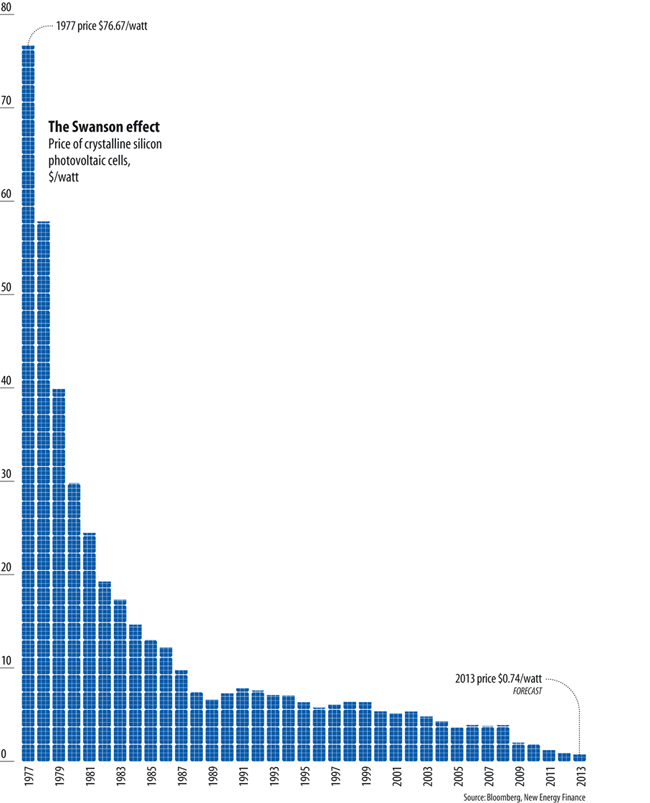
The International Energy Agency (IEA) recently released itsRenewable Energy Medium-Term Market Report 2014, revealing that although 2013 witnessed the fastest expansion of renewable energy capacity to date, the IEA expects the growth of renewables to slow in coming years. Despite the fact that renewable energy is becoming more affordable (including a precipitous decline in the price of solar photovoltaics), and thus more competitive with fossil fuels, the IEA describes how an unstable policy and market framework threatens the continued fast growth of the renewable energy sector.
This threat to the growth of renewable energy is especially pronounced in developed nations such as the United States. The IEA notes that countries like the United States “face challenges to maintain regulatory frameworks” that provide financial security for investors in renewable energy. In the United States in particular, the IEA notes that “questions persist over the durability of renewable tax incentives, and heated debates are occurring in a number of states over renewable portfolio standards and rules for promoting distributed generation.” For more on how the instability of federal tax credits affects the wind industry, see Sustainable Energy Subsidies, by GEI Director Melissa Powers. For more on some of this year’s conflicts over renewable energy policies at the state level, see The War on Renewables, by GEI Staff Attorney Amelia Schlusser.
In contrast, China and other developing nations seem to be taking the lead on renewable energy development. For example, the IEA projects that non-OECD nations will “account for around 70% of new renewable power generation from 2013-20.” It also notes that “China remains the anchor of renewable capacity deployment, accounting for almost 40% of the global expansion” to date. Moreover, China is likely to dramatically increase renewable energy deployment in the near future; an ambitious plan to encourage distributed generation in China aims to add as much as 14 gigawatts of solar power by the end of 2014.
The United States should be a leader in renewable energy policy and deployment. And to be fair, we are making progress. Wind is the fastest growing source of power in the United States, and the solar industry has enjoyed record growth recently. Nonetheless, despite the solar industry’s record growth in the United States, the IEA reports that in absolute terms China and Japan were last year’s leaders in solar deployment. To reclaim a position of leadership in renewable energy, federal and state governments in the United States should adopt a strong, stable policy framework to support renewable energy development. The Green Energy Institute plans to help design this policy framework; stay tuned for future blog posts and publications on how the United States should move forward.

Friday, September 5, 2014

Community Solar Introduction

By Kyra Hill, Energy Fellow
Part 1: A Brief Introduction to Community Solar
Even in notoriously overcast Portland, Oregon, the sun’s energy is extraordinarily powerful. A recent article in Forbesnoted that the rapidly falling costs of solar and access to better technologies for evaluating rooftop solar feasibility and battery storage are leading to increased efficiency at lower prices. Even the more conservative estimates anticipate a 128-fold increase in solar energy production over the next 20 years.  
Does this progress mean that with better, more affordable technology rooftop solar panels will become as ubiquitous as satellite dishes or chimneys? Unfortunately, the answer is no. Due to ownership, shading, and structural impediments, a National Renewable Energy Laboratory (NREL) study estimated that only 22 to 27% of residential rooftop area is suitable for hosting on-site photovoltaic (PV) systems. For the 73 to 78% of people who are unable to install their own PV arrays, community solar potentially offers a unique opportunity to either provide financial support for, or get power directly from, a centralized solar project.
How do community solar projects work? There are a number of different ways of setting them up, and next week’s blog with explore some examples. (For more on community solar designs, see the National Renewable Energy Laboratory’s guide to community solar.) But essentially community solar projects involve a centralized location that supports a single, commercial- or utility-scale PV array with many panels. Rather than supplying power to one business or one household, the array provides power to multiple participants who can all benefit.
The community solar structure will be an important component of any comprehensive solar energy adoption strategy for several reasons. First, community solar could provide many people who would otherwise be unable to procure solar energy (renters, those whose roofs receive too much shade, or those for whom purchasing or leasing an array is cost prohibitive) with the opportunity to do so. Second, community solar takes advantage of economies of scale. In other words, it brings down upfront costs because it involves one site—and therefore a single set of permits, feasibility studies, and other requirements—rather than several for a number of individual homes. Third, community solar reduces the area needed for construction, thereby reducing any potential environmental impact.
By casting a wider net and engaging a wider consumer base, community solar projects should become a key component to wide-scale deployment of renewable energy. The next posts in this series will explore community solar policies in greater detail, highlight some of the obstacles to community solar that remain, and offer suggestions for overcoming those obstacles. 

Wednesday, September 3, 2014

The Fulbright Begins

By Melissa Powers, Director of the Green Energy Institute
Greetings from the happiest nation on Earth! I am here in Copenhagen, Denmark, for about 3 months while I do research and writing as a Fulbright Scholar. Technically, I am a Fulbright-Schuman Scholar. Fulbright-Schuman Scholars—I think there are 6 of us this year—do comparative research in at least two European Union (EU) member states to gain a better understanding of how policies might work within the EU as a whole. We also do comparative analysis between policies in the EU and United States.
My specific research here is going to look at how two EU member states—Denmark and Spain—have promoted renewable energy development and what their experiences might teach us about renewable energy policy design in Europe, the United States, and potentially beyond. Denmark and Spain provide two very different examples of how countries have supported renewable power. Denmark announced in 2013 that it would obtain 100% of its electricity from renewable sources by 2050, while Spain suspended its renewable energy programs after the global economic crisis crashed Spain’s housing market and economy. Before the crisis, Spain’s renewable energy program was booming, and U.S. renewable energy advocates had pointed to Spain as an example of how a country could support renewable power. (Germany has since become the U.S. poster child for some renewables supporters, despite various signs that Germany is also facing several challenges.) Denmark, meanwhile, has generally flown under the radar, despite its longstanding support for renewables and steady progress towards its ambitious goals. My research will start in Denmark, as I look at how and why Denmark has supported renewable energy development, whether Denmark can achieve its ambitious 100% by 2050 goal, and what lessons Denmark might offer other countries and regions. In January, I will head to Spain and ask many of the same questions, but also look at how and whether Spain could restart its renewable energy development using different policies. Throughout my research, I will also consider how different U.S. states have approached renewables and the degree to which U.S. and EU approaches can inform each other.
Throughout my year as a Fulbright-Schuman Scholar, I will be blogging about my research, my observations, and my experiences in Europe. Some of these blogs will focus on specific issues related to renewable power policies—in which case, I’ll post them on the Green Energy Institute’s blog. Some of them will discuss my observations about the places I am going to visit and the people I meet. If they aren’t relevant to renewable power (although isn’t everything connected somehow?), I’ll post them on my Fulbright blogging page. I hope you enjoy the blog, and I’ll look forward to your comments. 

Thursday, June 26, 2014

The War Against Renewables

By Amelia Schlusser, Staff Attorney
Media pundits and conservative politicians increasingly bemoan the so-called “war on coal,” which seems to encompass any attempt to regulate greenhouse gas emissions from the electricity sector or advance renewable energy deployment. While I feel it is misleading and manipulative to use the word “war” in this context, the phrase invokes a powerful emotional response, and thus receives a fair amount of air time. It also overshadows a much more deliberate campaign being waged against renewable energy in many parts of the country, which threatens to reverse recent legal and policy advancements in the electricity arena.
Last month, the Kansas legislature rejected a bill that would have dramatically weakened the state’s renewable portfolio standards, or RPS, which requires Kansas electric utilities to obtain at least 20% of their electricity from renewable sources by 2020. The proposed bill, which would have revised the RPS to max out the renewable energy standard at 15% by 2016, was rejected by the Kansas House of Representatives by three votes.
This bill was one of numerous legislative efforts to weaken the Kansas RPS over the past two years, and likely will not be the last. These efforts to roll back the state’s renewable energy goals have not been raised at the behest of Kansas citizens, or even Kansas businesses, save for one. According to Kansas State Representative Scott Schwab, Koch Industries, a Wichita-based multinational corporation with extensive oil and natural gas interests, is responsible for the legislative attempts to weaken or repeal the RPS. Billionaire brothers Charles and David Koch also fund the Kansas Chamber of Commerce’s political action committee, and Schwab, a five-term republican representative, claims that the group recently refused to endorse him because he opposed weakening the state’s RPS. The Chamber of Commerce also allegedly withdrew support for three other Republican incumbents for their failure to support the RPS bill.   
Ohio is another battleground in the fight against renewable portfolio standards. On June 13, Ohio Governor John Kasich signed S.B. 310, a bill that freezes the state’s RPS and energy efficiency standards for two years, making Ohio the first state in the country to roll back these standards. On June 23, Governor Kasich signed a separate bill that will likely halt wind energy development in the state. H.B. 483 mandates that commercial wind turbines be set back at least 1,125 feet from any property line. The new setback requirement will drastically reduce the number of turbines that can be installed at a single location, making commercial wind development uneconomical in most locations.
Thanks to Kansas’s RPS, a robust wind industry has emerged in the state, creating 13,000 new jobs and attracting more than $7 billion in investments. In Ohio, the state’s energy efficiency standards have saved consumers more than $1 billion in energy costs, and the RPS has attracted more than $1 billion in renewable energy investments Yet FirstEnergy Corp., an Akron electric utility, wrongly claimed the RPS and energy efficiency standard freeze would benefit consumers and create jobs.
At the heart of this issue lies a deeper debate with potentially profound social, economic, and environmental significance. Should we, as a society, continue to prop up polluting fossil fuel-based electricity generation in exchange for lower short-term electricity rates, or should we instead aim to reduce long-term societal costs resulting from fossil fuel emissions—including costs associated with environmental degradation, human health impacts, and climate change—and invest in a clean renewable energy system? If we choose the latter option, there will be significant economic impacts in the short-term, with economic losses for the fossil fuel industry and economic growth for the renewable energy industry. This type of economic transition isn’t unprecedented; over the last century we’ve witnessed the transition from the telegraph to the smart phone and the printing press to the 3D printer. It’s perhaps more surprising that we’ve used the same general technology to generate electricity for over 100 years.
We now have the technology to generate electricity from the sun and the wind, yet we continue to level entire mountains to obtain polluting, non-renewable fossil fuels. And when fossil fuel-funded politicians rant about the “war on coal,” they promote the battle against renewable energy. Unfortunately, it seems this battle will continue until we build the political will to transition to a modern, 21st century electrical system. 

For more information on the Kansas RPS controversy, click here.
For information on Kansas’s wind industry, click here.
For information on Ohio’s RPS freeze, click here.
For more information on H.B. 483, click here.

Thursday, February 13, 2014

Withdrawal of Assembly Bill 177 Threatens California’s Renewable Energy Leadership

By Nick Lawton, Energy Fellow

California has long been a leader in renewable energy policy, but the withdrawal of Assembly Bill 177 threatens the state’s leadership by failing to strengthen its renewable portfolio standard (RPS). California was among the first states to adopt an RPS in 2002, requiring utilities to produce or procure a certain portion of renewable energy by a certain date. California originally required 20% renewable energy by 2017 and has strengthened its RPS twice since. Today, California’s RPS is among the strongest in the nation, requiring utilities in the state to produce or procure 33% of its energy from renewable sources by 2020. Assembly Bill 177 (A.B. 177) would have strengthened the state’s RPS further, requiring 51% renewable energy by 2030 and making California by far the most ambitious state when it comes to renewable energy policy.
Assemblyman V. Manuel Perez withdrew A.B. 177 from consideration last week. A series of committee votes had added language to the bill that would have allowed utilities to consider the costs of integrating renewables into the electricity grid when deciding which renewable energy to buy. This provision likely would have helped geothermal energy, one goal of Assemblyman Perez, who hails from a region that would benefit from increased geothermal development. However, Assemblyman Perez cited concerns that this new provision would likely increase utility rates further than the original bill. Erica Felci at the Desert Sun quotes Assemblyman Perez as opposing “a bill that could potentially raise costs for wind and solar, and ultimately the ratepayer.”
In sum though, Assemblyman Perez’s withdrawal of A.B. 177 flinches from the reality that different types of renewable energy will inevitably compete as states transition to grids fed chiefly by renewables. Mr. Perez was undoubtedly correct that factoring in integration costs would have favored geothermal power over intermittent sources such as wind and solar power. However, considering such differences in renewable energy sources is eminently rational. Indeed, as California and other states move toward renewable energy, they should consider all the various costs and benefits of different energy sources. Failing to strengthen the state’s RPS for fear that an honest accounting of integration costs may favor one form of renewable energy over another is poor policy and threatens California’s position as a renewably energy policy leader.