Friday, October 17, 2014

GEI Submits Comments to Hawaii PUC Regarding HECO Company Plans

By Nate Larsen, Energy Fellow

The Green Energy Institute submitted comments to the Hawaii Public Utilities Commission on October 6, 2014, in response to the HECO Companies’ Power Supply Improvement Plans (PSIPs) and Distributed Generation Improvement Plan (DGIP). GEI’s comments dealt specifically with the HECO Companies’ proposals to eliminate or cap participation in Hawaii’s Net Energy Metering program and to assess fixed charges for distributed generation customers.  
Eliminating the Net Energy Metering Program
The HECO Companies filed their PSIPs and DGIP with the Hawaii PUC on August 26, 2014. The Companies used that platform to recommend eliminating the state’s Net Energy Metering (NEM) program. In their DGIP, the Companies asserted that “[t]he need to provide retail compensation for DG no longer exists,” arguing that utility-scale PV projects can be built at rates below the retail cost of electricity. The Companies further stated that “the intent of the NEM program at its inception, in combination with federal and state incentives, was to nurture a developing technology and industry, because the cost to self-generate clean renewable energy was prohibitive.” Based on those conclusions, the HECO Companies sought to eliminate or limit the scope of Hawaii’s NEM program.
Citing inequities in cost allocation among customer classes, the Companies first recommended a “Gross Export Purchase” model, which would effectively replace the net-metering regime with a feed-in tariff for DG customers at rates nearer to the wholesale price of electricity. In response to that proposal, GEI noted in our comments that the legislature created the NEM program by statute, and that the Hawaii PUC therefore lacks the authority to abolish the program by adopting the Companies pricing model. We recommended that the Hawaii PUC require the HECO Companies to provide alternative proposals to address those perceived cost allocation issues.
The HECO Companies’ second proposal involved the Hawaii PUC capping participation in the state’s NEM program, which they have the authority to do under the net metering statute. However, in 2008, stakeholders—including the Governor of Hawaii, consumer advocates, and the HECO Companies—signed an energy agreement providing, among other things, that there should be no system-wide caps on net metering. GEI pointed out that even if the Hawaii PUC has the authority to reinstate caps on the NEM program, doing so would conflict with the energy agreement, and thus would constitute bad policy on the part of the PUC.
Assessing Fixed Charges
As I discussed in an earlier post, the HECO Companies also envisioned adopting fixed charges to address some of the cost allocation issues associated with distributed generation. In their PSIPs, the Companies assess the bill impacts of fixed charges in the amounts of $55 for all customers and an additional $16 for DG customers. In our comments, GEI warned the PUC about the potential impacts that fixed charges would have on conservation and customer retention. 
First, GEI pointed out that the adoption of fixed charges would lower the volumetric price of power. That reduced cost per kilowatt-hour may then obscure price signals to use less electricity. Second, GEI noted that high fixed charges for DG customers—like those used in the HECO Companies’ PSIPs—could create an economic incentive for customer grid defection. That defection would only serve to heighten cost allocation issues, by reducing the utilities’ customer pools without substantially reducing their operating expenses. GEI then urged the Hawaii PUC to consider all the benefits that DG customers provide to the system in future ratemaking proceedings, including the rate benefits to other utility customers discussed above, as well as avoided transmission and distribution costs, and environmental and societal benefits resulting from the use of carbon-free, clean resources.
Conclusion
Hawaii is the first state to take concrete steps towards a new paradigm in electricity regulation, and has therefore become something of a laboratory for the “Utility 2.0” reforms expected eventually to sweep the country. GEI supports the Hawaii PUC’s efforts to reform the electricity sector to reflect emerging trends; our comments reflect our desire to ensure that those reforms continue to provide customers with the choice to economically install and operate distributed generation systems.
The Hawaii PUC is currently reviewing the HECO Companies’ PSIPs and DGIP, as well as the public comments on those plans, pending further action on the matter.

Wednesday, October 15, 2014

Part 6: Community Solar Mise-en-Place

By Kyra Hill, Energy Fellow

Around the nation, independent local groups are beginning to develop community solar projects. Last week, I discussed how exemptions to burdensome securities laws could help facilitate that process. But even with securities exemptions in place, community solar projects can be difficult to organize, design, and finance. Despite these difficulties, some community groups have come together to develop successful community solar projects in various states. Successful projects have several common ingredients that must be put in place (much like the French culinary practice mise-en-place) before they begin production. This post explores those ingredients and offers some suggestions for how community groups, policymakers, and solar advocates can facilitate community-led solar project development.
Ingredient 1: Consult Available Guides and Tools
Community members interested in developing their own projects should consult publicly available resources and familiarize themselves with existing successful projects. In 2012, The National Renewable Energy Laboratory (NREL), along with the Bonneville Environmental Foundation and Northwest SEED, published an updated version of their community solar guide. The guide provides an accessible introduction to community solar models, touches upon some hurdlesto developing them, and outlines the general process for developing a community solar project. Other resources, including regional,international, and state-specific guides similarly provide direction and can help identify likely obstacles. 
Ingredient 2: Organize and Engage Community Members 
Community advocates should begin by assessing community (and utility) interest in a particular project. Limited community interest should not necessarily counsel against a particular project, but should instead reveal the need for more outreach and education about the project’s social, environmental, and financial benefits. Educational efforts might include holding meetings and community outreach. Electing project leaders and recruiting volunteers with legal or business expertise can diminish project complexity. One group in Maryland, for example, secured pro bono securities and tax assistance from a law firm and a law school clinic. Community members helped one District of Columbia Cooperative raise funds and build a website, and local children even helped with door-to-door sales outreach. Northwest Seed’s guide provides a useful chart identifying community organizations (e.g., schools, homeowner associations, etc.) and community members who could help overcome some technical and financial hurdles. Effective communityengagement and information sharing could appreciably reduce the costs of developing a community-initiated solar project.
Ingredient 3: Conduct Feasibility Analysis and Begin Project Development
The feasibility analysis and site assessment process includes identifying where the best solar resources are located, assessing which solar modules and setup works best for that site, and ensuring the project’s financial viability. There are a number of modeling tools available to facilitate this process, and as technology continues to improve, these assessments should become easier.
The project development phase is time-consuming and complex. The Maryland group spent almost two years working through this process. It includes navigating applicable regulations and permit requirements (such as electrical permits, building permits, and potentially even permits to maintain solar access), establishing a business or ownership structure, developing a financing plan, negotiating power arrangements and interconnection agreements, and obtaining bids from installers. Each of these components requires either professional or local government assessment, and is therefore likely to be costly, lengthy or both.
Here, too, information sharing and identifying best practices could help to reduce financial burdens. Recognizing that the hurdles to developing a community solar project stem from the project development process, some groups attempt to make projects replicable by sharing information to help ease burdens for future efforts. But because many of these projects remain site- and project-specific—and therefore require individual negotiations, financial disclosures, and permits—information dissemination can only go so far. Changes at the policy level could drive down non-hardware costs and streamline the permitting process. (See my colleague Nick Lawton’s report on decreasing these so-called “soft costs.”) Technological changes and increased familiarity with these projects will also ease their development.
Even though utility-led community solar projects can be easier to develop, finance, and design, community-initiated projects are cropping up in several states. Community-led projects are attractive because they engage members in renewable energy production while providing local economic benefit. Successful projects take the time to consult available resources, engage community members, and create viable business plans. Developers can facilitate this process by sharing information and best practices. Solar advocates can galvanize community members around these projects. Finally, policymakers can play an important role by helping to decrease soft costs and eliminating administrative burdens. With the right combination and preparation of ingredients, community-initiated solar projects can play an important role in promoting widespread renewable energy adoption.

Monday, October 13, 2014

Better Weather Forecasting Reduces Wind Integration Costs

By Amelia Schlusser, Staff Attorney
Wind energy is an increasingly cost-effective source of electricity. According to Lazard’s Levelized Cost of Energy Analysis version 8.0, the levelized cost of unsubsidized wind energy currently ranges from $37 to $81 per megawatt hour (MWh). When the calculation includes  federal tax incentives, levelized costs fall to between $14 and $67 per MWh. In contrast, the levelized cost of natural gas combined cycle technologies ranges from $61 to $87 per MWh, while the cost of coal ranges from $66 to $151 per MWh. On a levelized cost basis, therefore, wind energy is currently cost competitive with conventional fossil fuel resources.
However, the intermittent nature of wind energy presents challenges for integrating this resource onto the grid. Grid operators face significant uncertainty regarding the availability of wind energy, which varies significantly from hour-to-hour and day-to-day. This variability forces grid operators to make rapid adjustments to accommodate load increases and decreases that fluctuate with weather conditions. Operators must keep other generating resources on reserve to provide back-up power for low-wind periods, which can add significant cost on a per-MWh basis.
Idaho Power Company recently developed a new forecasting tool that allows grid operators to more cost-effectively integrate variable wind energy onto the grid. This Renewables Integration Tool, or RIT, consists of a number of models and databases that forecast hourly and daily wind conditions and project the amount of wind energy the utility can procure on an hourly basis. The RIT incorporates data on weather conditions, turbine performance, and supply and demand conditions within Idaho Power’s service territory, and allows the utility to better predict wind energy availability from 72 to 180 hours into the future.
During the first quarter of 2014, Idaho Power determined that the RIT was 26% to 32% more accurate than the utility’s previous forecasting methods. This increased forecasting accuracy has enabled the utility to reduce grid integration and operating costs by $287,000 over a three-month period. While these cost savings are significant, Idaho Power notes that the accuracy of the RIT’s forecasts vary during periods of unpredictable weather, and plans to continue refining the software to further improve the utility’s ability to integrate wind energy onto the system.
While the electrical sector still has a long way to go to fully integrate intermittent renewable energy generation onto the grid, better forecasting methods such as Idaho Power’s RIT enable utilities to integrate additional renewable resources at a lower cost to consumers. These reduced integration costs in turn increase the value of renewable energy. Other utilities should follow in Idaho Power’s footsteps to develop customized forecasting tools to facilitate integrating variable renewable energy resources onto the grid.

Tuesday, October 7, 2014

Push and Pull: A Federal Tug of War over Renewable Energy

By Nick Lawton, Staff Attorney
Fickle federal policies are sending conflicting signals to renewable energy developers. On the one hand, the federal government seems to recognize the critical role that U.S. public lands could and should play in siting the most efficient, productive renewable energy facilities. For example, as I reported a few weeks ago, Congress is considering a bill that would expand leasing opportunities for renewable energy development on federal lands. Similarly, the Bureau of Land Management (BLM) has been working with various stakeholder groups to plan for optimal siting of solar power in the desert Southwest. But on the other hand, short-lived federal tax policies designed to spur renewable energy in fact deprive the industry of the certainty needed for steady market growth and drive an unsteady, boom-and-bust cycle of development.
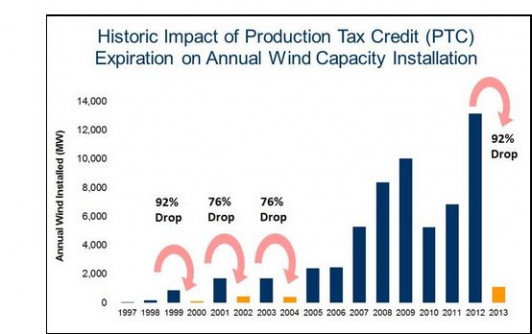
The federal Production Tax Credit (PTC) is the cardinal example of fickle federal policy. Although renewable energy advocates and industry strongly support the PTC, which provides an inflation-adjusted payment for renewable energy delivered to the grid, Congress has allowed the PTC to lapse five times since its initial passage in 1992. The PTC expired most recently at the end of 2013, and although some members of theHouse and Senate support its resurrection, Congress seems unlikely to act any time soon.  The likely consequence is a severe reduction in investment in wind and other renewable energy, as the following graph from the American Wind Energy Association illustrates:
image
For a detailed discussion of the PTC’s history, functioning, and proposals for its extension or modification, please see Sustainable Energy Subsidies, by the Green Energy Institute’s director, Professor Melissa Powers.
The federal Investment Tax Credit (ITC), which has allowed recovery of 30% of a solar energy system’s cost since 2008, now faces a similarly uncertain future. Unless Congress acts, the ITC will diminish severely at the end of 2016. Large commercial projects will see the credit plunge to only 10% of a project’s cost, while residential projects will no longer enjoy any credit at all. Again, although some members of Congress are attempting to extend the ITC, its fate remains profoundly uncertain. This coming blow risks disrupting the solar industry’s recent trend of record-breaking growth.
In fact, uncertainty over the expiration of the ITC is already impacting solar development. A developerrecently withdrew plans for a proposed utility-scale concentrating solar plant in California. Although the developer did not officially attribute the project’s cancellation to the expiring ITC, David Danelski at The Press Enterprise reports that one of the developer’s vice presidents as doubting the project could be completed in time to take advantage of the tax credit before it expires. Mr. Danelski also cites a source from the Solar Electric Power Association, as noting that guaranteed receipt of the ITC is critical for financing solar projects.
The United States should do better. Renewable energy is an important, burgeoning industry that simultaneously offers significant environmental benefits and economic growth. For example, the solar industry now employs more workers than the coal and natural gas industries. Wind energy was thefastest growing source of energy in 2012 and has provided more than a third of new energy-production capacity over the last six years. In 2014 alone, U.S. investment in renewable energy amounted to $7.3 billion.
Stable federal policies are key to fostering this important industry. However, even as federal planning for renewable energy development proceeds, the federal government is failing to offer the kind of certainty that industry requires. The United States has already fallen behind China in solar deployment and lags well behind Europe in the development of offshore wind. Australia provides a chilling cautionary tale: once the 11th largest investor in renewable energy, recent political disputes over the nation’s support for renewable energy have led it to decline to 34th, behind significantly less developed nations like Myanmar. If the United States hopes to be a competitor, much less a leader, in the development of renewable energy, it should pass significant reforms to make federal policies more coherent, stable, and supportive.

Monday, October 6, 2014

Part 5: Can Securities Exemptions Eliminate Community Solar Obstacles?

By Kyra Hill, Energy Fellow
When I discussed community solar models and obstacles, I mentioned that the requirements for securities registrations can be a significant obstacle. However, the obstacles are not insurmountable. Recent legislative and executive actions inOregonVermont, and at the federal level illustrate how involvement and advocacy from solar advocates can improve burdensome laws and regulations. 
Why Community Solar is a Security
The definition of a security includes membership in a profit-sharing agreement. Any community solar model that involves financial investment with the expectation of some return on that investment (or even potentially on-bill credits or other benefits) will likely qualify as a security. Why does this matter? The Securities and Exchange Commission (SEC) requires those offering securities to make certain filings and disclosures in order to provide adequate information to potential investors. Securities registration and disclosure requirements have virtues and vices. On the one hand, they protect against fraud by providing necessary information about investment opportunities to potential investors. But on the other hand, the costs (time, money, and paperwork) can be extremely burdensome for small, community-based projects.  
SB 1520: Oregon’s Securities Exemption
When Oregonians for Renewable Energy Progress (OREP), a renewable energy advocacy group in Oregon, attempted to help form a solar cooperative in Corvallis, they quickly ran up against a costly and time-consuming securities filings process. Although federal law exempts wholly in-state offerings from registration and disclosure requirements, states have their own processes (called “blue sky laws”) that involve their own fees, paperwork, and disclosure requirements. But state blue sky laws can also provide exemptions for certain types of securities. For example, Oregon’s statute provides exemptions for certain types of cooperatives. Through the efforts of community members and OREP, the Oregon State Legislature passed Senate Bill 1520adding solar cooperatives to the listed of cooperatives exempted from the state securities filings requirements.
Yet, this picture is neither complete nor completely rosy. The amendment to the existing exemption allows theDepartment of Consumer and Business Services (DCBS) to essentially impose any restrictions or additional requirements it deems necessary to protect unwary investors from suspect solar scams. It remains to be seen whether these restrictions will relieve much, if any, of the major securities filings obstacles. DCBS has yet to issue its final rules, though the proposed version went through a notice and comment process. (See GEI’s comments on these proposed rules.)
Importantly, the Oregon exemption is limited to community renewable cooperatives, likely because it fit squarely within an existing exemption. In order to incentivize a broader scope of potential community solar models, though, other structures may need similar exemptions. 
Vermont’s “SUN” Exemption
Vermont’s “Vermont Solar/Utilility No-Action” (charismatically abbreviated “SUN”) community solar exemption gets right what Oregon’s statute does not. Rather than exempt only solar cooperatives and impose a blanket set of restrictions on them, the SUN exemption recognizes that different groups of investors deserve different levels of consumer protection. The SUN exemption breaks down the potential groups into four sub-categories, each comprising a different set of potential investors. For example, a potential group of investors expecting to enter into long-term agreements without a termination right rightly deserves a substantial amount of information before making a decision. The SUN act therefore places significant disclosure requirements and advertising restrictions on the “Financing Exemption” group. On the other hand, a small group of neighbors, friends, or family (e.g. cooperative) wanting to invest in a community solar project may need less protection. Vermont’s “de minimis” exemption therefore provides such a group with a blanket, self-executing exemption that requires no disclosures.
Vermont is a state with a significant amount of support for, and investment in, renewable energy. If this relatively new exemption proves successful in spurring more community solar development there, its well-crafted model should serve as an example for other states.
The Proposed Federal Crowdfunding Exemption
Exemptions occur at the federal level as well. Recently, the SEC proposed rules that would flesh out securities requirements for crowdfunding under the Jumpstart Our Business Startups (“JOBS”) Act. Crowdfunding, as I discussed in Part 2 of my community solar blog series, has emerged as a potential way to fund community solar projects through small online donations or investments. Though the rules are not yet finalized, they will likely attempt to strike a balance between providing adequate investor protection and easing the burden on startups that operate through the crowdfunding mechanism. Potential ways of doing this include requiring certain disclosures to potential investors and imposing restrictions on available funding platforms.
Moving Forward
Providing adequate investor protections while fostering the development of community solar projects is a difficult balance to strike. The regulations and statutes discussed above at the very least make attempts at doing both, with varying degrees of success. Perhaps once the community solar concept gains more traction, regulators and lawmakers will be less weary of questionable investment schemes and more willing to require less costly disclosure processes. Ideally, the SEC and states should craft exemptions similar to Vermont’s, recognizing that not all community solar models are cut from the same cloth.  Until then, though, those seeking to form community solar entities will likely have to continue navigating the gnarly weeds of securities filings requirements and exemption regulations.

Friday, October 3, 2014

Bringing Utilities into the Sun: Measuring and Mitigating PV Impacts

By Nick Lawton, Staff Attorney

Electric utilities in the United States are wary of solar power. For example, a 2013 report from the Edison Electric Institute, an electric utility trade organization, characterized solar power as a “disruptive threat” to traditional electric utility business models. That report cautioned that distributed solar power could pose the same kind of challenge for utilities that cell phones posed for copper-wire phone companies. The basic fear is that decreasing costs of solar power and increasing utility bills will drive ever-greater deployment of distributed solar, reducing customer numbers and threatening utilities’ bottom lines.
Of course, solar power currently contributes only a very small portion of power in the United States (0.2% in the nation, and 2% in the most solar-friendly jurisdictions), suggesting that the U.S. solar industry has a long way to go before it significantly impacts utilities. Indeed, a recent study from Lawrence Berkeley National Laboratory (LBNL) concludes that “utilities, policymakers, and solar stakeholders likely have sufficient time to address these concerns in a measured and deliberate manner.” However, the potential impact on utilities is not entirely theoretical. The Economist reports that renewable energy development is partly responsible for a decline in value of European utilities that amounts to roughly half a trillion Euros. (Of course, the Economist also notes that renewable energy is not the sole driver of impacts on European utilities; other contributions include over-investment in fossil-fuel generation assets and dwindling energy demand.) Policy makers in the United States should try to prevent similar impacts to U.S. utilities.
Although some scholars, such as the Rocky Mountain Institute’s founder Amory Lovins, argue that policy makers should not protect utilities, I believe that finding ways to measure and mitigate utility impacts is important for several reasons. First, and most importantly, utilities play a critical role in managing and updating the energy grid. If utilities lose value and cannot attract capital, they may not be able to finance significant grid upgrades that will be necessary to integrate and manage variable sources of renewable energy. Second, utilities’ longstanding guaranteed profitability has attracted significant investment from pension funds. If utilities lose value suddenly or dramatically, pensioners could feel the pinch. And finally, to the extent utilities view renewable energy as a threat, they are likely to wield their political power to slow or stall renewable energy development. Understanding and reducing impacts to utilities could prevent such unintended consequences. Moreover, as allies of solar power, utilities could dramatically expand deployment.
My colleague Nate Larsen’s blog post this week, Distributed Generation Rate Reform Around the U.S., discusses potential measures in several states that aim to restructure utility billing practices to account for impacts from distributed energy generation such as solar power. Nate’s post highlights examples of policy options currently under consideration as part of a comprehensive assessment of various utility reform policies. His roundup of state efforts is a valuable contribution that illustrates a common approach: increasing fixed charges to ratepayers and adding fixed charges to net-metered customers. This particular approach mirrors recommendations from the Edison Electric Institute’s report.
However, fixed charges are by no means the only policy option for mitigating PV’s impacts on utilities.LBNL’s recent study reveals several strong policy options that could maintain utility profitability even in the face of dramatically expanded solar deployment. That study examined scenarios in which solar power accounted for 2.5% or 10% of total retail electricity sales. The 2.5% scenario mirrors deployment levels in utility jurisdictions with the greatest solar penetration (excluding Hawaii, a special case), while the 10% scenario far exceeds current deployment. The study quantifies impacts of these levels of solar deployment on two model utilities: one vertically integrated utility typical of the Southwest; and one “wire-only” utility typical of the Northeast (which owns only the distribution grid, and not the transmission grid or generation assets). The study finds that while ratepayer impacts would be modest—raising electricity rates by less than 3%—impacts on utility earnings and shareholders could be severe. For example, increased solar deployment could reduce both model utilities’ return on equity by between 8% and 15%. More dramatically, 10% solar deployment could reduce the Northeastern model utility’s earnings by up to 41%, an outcome which resembles the current plight of some European utilities. LBNL also examines a variety of policy options to mitigate these utility impacts.
Notably, LBNL projects that several policy options may be sufficient to offset impacts on utility earnings or return on equity. In other words, distributed solar power does not have to harm utility profitability, and LBNL’s report identifies several policies that may offset impacts to utility earnings or returns on equity. For example, LBNL asserts that alternative ratemaking approaches—including more frequent rate cases, less lag between rate cases and rate implementation, and the choice of different test years in rate cases—could more than offset utility revenue impacts. Similarly, LBNL notes that shareholder incentive mechanisms, like those that many states use to encourage energy efficiency, may significantly offset reduced utility earnings and return on equity. Intriguingly, LBNL did examine the imposition of fixed charges, noting that while fixed charges seemed to help the model Southwestern utility, high fixed charges could actually worsen the situation for the wires-only Northeastern utility (because the customer base in the Northeast is growing more slowly).
The option LBNL examines that I find most interesting is utility ownership or financing of PV installations. Even owning or financing only 10% of solar installations could significantly offset utility impacts. However, the potential impact of utility ownership is much more significant in the Northeast, where the model utility does not otherwise own generation, than in the Southwest, where the model utility does. The option of utility financing or ownership is particularly interesting because it can also help reduce the costs of, and improve access to, solar power. Utilities generally have a low cost of capital, which would allow them to build solar facilities with lower soft costs than others generally can. Moreover, utility financing (in which a customer purchases a solar facility through on-bill payments over time) could allow those who lack significant access to capital to nonetheless enjoy the benefits of solar PV. In other words, utility ownership or financing of solar power could solve multiple problems simultaneously.
LBNL’s new report is a very valuable resource for those considering how to measure and mitigate impacts on utilities from solar PV or other distributed energy sources. However, this report by no means solves the puzzle of how to harmonize the stability of utilities with accelerating distributed renewable energy development. For example, LBNL cautions that there is no one-size-fits all approach; utility regulation and business models vary throughout the country, and sensible policy reforms will need to vary as well. More significantly, LBNL itself candidly notes that many of its proposed strategies involve difficult trade-offs between different policy goals. For example, LBNL notes that allowing utilities to earn renewable energy credits from customer-sited PV arrays would bolster utility profitability, but would also diminish the efficacy of renewable portfolio standards by reducing the amount of renewable energy development necessary for compliance. Similarly, many strategies that favor utility shareholders work against ratepayer interests.
LBNL’s report presents a valuable array of options, but careful consideration of each is necessary in order to find the best way to promote renewable energy while avoiding debilitating impacts to utilities. The Green Energy Institute is considering these and other policy proposals to help develop carefully tailored strategies to encourage utilities to be eager participants in a renewable energy future.

Wednesday, October 1, 2014

Distributed Generation Rate Reform Around the U.S.

By Nate Larsen, Energy Fellow

The idea of reforming the retail electricity pricing model to more accurately reflect the actual cost of utility services has been around for some time, but the rapid growth of customer-owned distributed generation (DG) has recently brought the issue to the fore. The proliferation of residential solar installations, in particular, has driven some state public utility commissions (PUCs) to take up the issue of reforming retail rates to equitably allocate the costs of providing service to DG and non-DG customers alike. Many utilities, meanwhile, are seizing the moment to attempt to raise fixed charges and impose surcharges on net metering customers. In addition to perceived issues of cost-shifting, utilities worry that significant penetration of customer-sited DG will cut into their profits and potentially leave them with considerable stranded infrastructure costs.
PUCs have, to this point, shown a reluctance to impose significant new costs to net metering customers.
As retail electricity rate reform advances around the country, utilities, policymakers, ratepayer advocates and renewable energy proponents will seek a compromise that provides an equitable allocation of costs across electric customer classes. As with any compromise, the solution will likely lie somewhere in between the current regime of low fixed charges and relatively high net metering compensation, and the significant fixed charges proposed by the utilities. The Green Energy Institute’s Policy Analyst, Nick Lawton, will highlight potential policy solutions and alternative approaches to the issues of cost-shifting and utility unprofitability in a forthcoming blog post.
The following is a brief look at some of the distributed generation rate reforms proposed and adopted around the country.*
Arizona:
In approving a $0.70/kw charge for net metering customers on November 14, 2013, the Arizona Corporation Commission (ACC) rejected recommendations for higher charges from Arizona Public Service (around $8.00/kw), the Residential Utility Consumer Office (around $3.00/kw), and the Commission’s own staff (around $3.00/kw). The Commission left open the possibility of increasing those rates in the next rate case.
Status: The ACC approved a $0.70/kw charge for net metering customers.

Hawaii:
As discussed in last week’s post, the Hawaii PUC recommended sweeping changes to the state’s electric industry regulatory regime, including revisions to the retail electricity rate structure. Pursuant to a PUC order, the HECO Companies filed a Power Supply Improvement Plan (PSIP) and a Distributed Generation Improvement Plan (DGIP) that proposed:
  • A fixed monthly charge applied to all customers.
  • An additional fixed monthly charge applied only to new DG customers.
  • A “Gross Export Purchase model” for export DG.
The HECO Companies’ proposed “Gross Export Purchase model” would effectively supplant net metering in the state.
The HECO Companies’ PSIP recommend that those charges be set at the following levels: a $55/month fixed charge for all customers, a $16/month fixed charge for DG customers, and a $0.16/kwh feed-in-tariff paid to DG customers.
Status: Comments on HECO Companies’ proposed reforms are due to the PUC on October 6.

Nevada:
On September 26, 2014, the Nevada PUC voted to ask the legislature for guidance on changes to the state’s net metering policy. The PUC seems to have requested that the legislature consider whether to allow the PUC to assess charges to net metering customers. Currently, net metering customers are statutorily entitled to the same rates as non-DG customers.
Status: The PUC’s request is awaiting legislative action.

New York:
On April 24, 2014, the Department of Public Service issued a straw proposal for sweeping reforms of the electricity industry, Reforming the Energy Vision (REV). One of the recommended changes involved unbundling retail electricity rates to reflect the actual costs of providing the various products and services associated with the provision of electricity service. The REV elaborates:
“Because the transactions between customers and the [distribution utility] will be two-way, the rate designs under REV will need to reflect: the value of grid service to consumers with DER [Distributed Energy Resources]; the value of grid service to consumers without DER; and the value that DER can provide to the grid. Reflecting these energy values in future rates and tariffs will require a greater unbundling of these products and services. Payment structures for DER should reflect the value based on timing, location, flexibility, predictability and controllability of the resource.” REV at 58.
Status: The New York State DPS recommended unbundling retail electricity products and services. The Department will solicit public input on the proposed reforms in a future proceeding.

Oklahoma:
On April 15, 2014, Governor Mary Fallin signed SB 1456 into law, requiring the Oklahoma Corporation Commission to set up a process for establishing a surcharge for net metering customers. The law applies to net metering customers whose systems are placed in service after November 1, 2014.
Status: The Oklahoma Corporation Commission is awaiting proposals by the state’s electric utilities regarding net metering charges.

Utah:
The Utah Public Services Commission ruled that more evidence is required to evaluate Rocky Mountain Power’s proposed fixed charge of $4.65/month for net metering customers. The utility proposed the charge in November 2013. The Public Services Commission scheduled a conference on the matter for November 5, 2014.
Status: The Public Services Commission delayed a decision on Rocky Mountain Power’s proposed fixed charge for net metering customers, pending a conference on the issue on November 5, 2014.

Wisconsin:
Three Wisconsin utilities—We Energies, Madison Gas & Electric, and Wisconsin Public Service Corp.—recently proposed raising fixed charges for all customers. We Energies proposed an increase from $9/month to $16/month; Madison Gas & Electric proposed an increase from $10.50/month to $19/month; and Wisconsin Public Service Corp. proposed an increase from $10/month to $25/month. 
In addition to We Energies’ proposed increase in fixed charges, the utility also proposed a net metering surcharge of $3.80/kw.
Status: Public comments on We Energies’ proposed charges are due to PSC on October 7.

PUCs have taken limited action to date on adopting DG-customer charges, but utilities’ calls for reform are picking up steam. While PUCs should be considering the cost-allocation issues caused by a proliferation of DG customers, so too should they be considering the environmental and avoided transmission and distribution cost benefits that DG customers provide.
Utilities, for their part, should devote considerable attention to adapting their business models to stay relevant in a changing industry, rather than solely advocating for increased fixed rates and the elimination of net metering. Potential adaptations  include increased investment in modernizing the distribution system and using utility expertise and access to capital to develop and interconnect customer-sited distributed energy resources. (These concepts will be covered in more detail in Nick Lawton’s forthcoming blog post.)
DG rate reform is just one aspect of the sweeping reforms anticipated by many involved with the electricity industry. As the efforts of early-adopter states like Hawaii and New York begin to produce results, it will become increasingly likely that other states undertake to revise their regulatory regimes to reflect the more distributed electricity system of the future. 

* While this list was compiled to present some of the most notable instances of DG rate reform in the country, it is not meant to be comprehensive; utilities and state PUCs are taking action on the issue a dizzying pace.

[For a comprehensive introduction to the issue of retail electricity rates and the need for reform, click over to this (prescient) article from the July 1, 2000 issue of Fortnightly Magazine.]